
Introduction
The goal of the micro-scenario approach is to collect evaluations across a wide range of topics on a few selected response variables, interpret these in terms of both 1) individual differences and 2) topic-specific judgments, and situate the different evaluations within a broader, comparative context (see the publication). To do so, participants are presented with a large number of short scenarios and their evaluations are measured using a small set of response variables. The scenario stimulus can be a short descriptive text, images, or, in extreme cases, just a single word representing the evaluated concept.
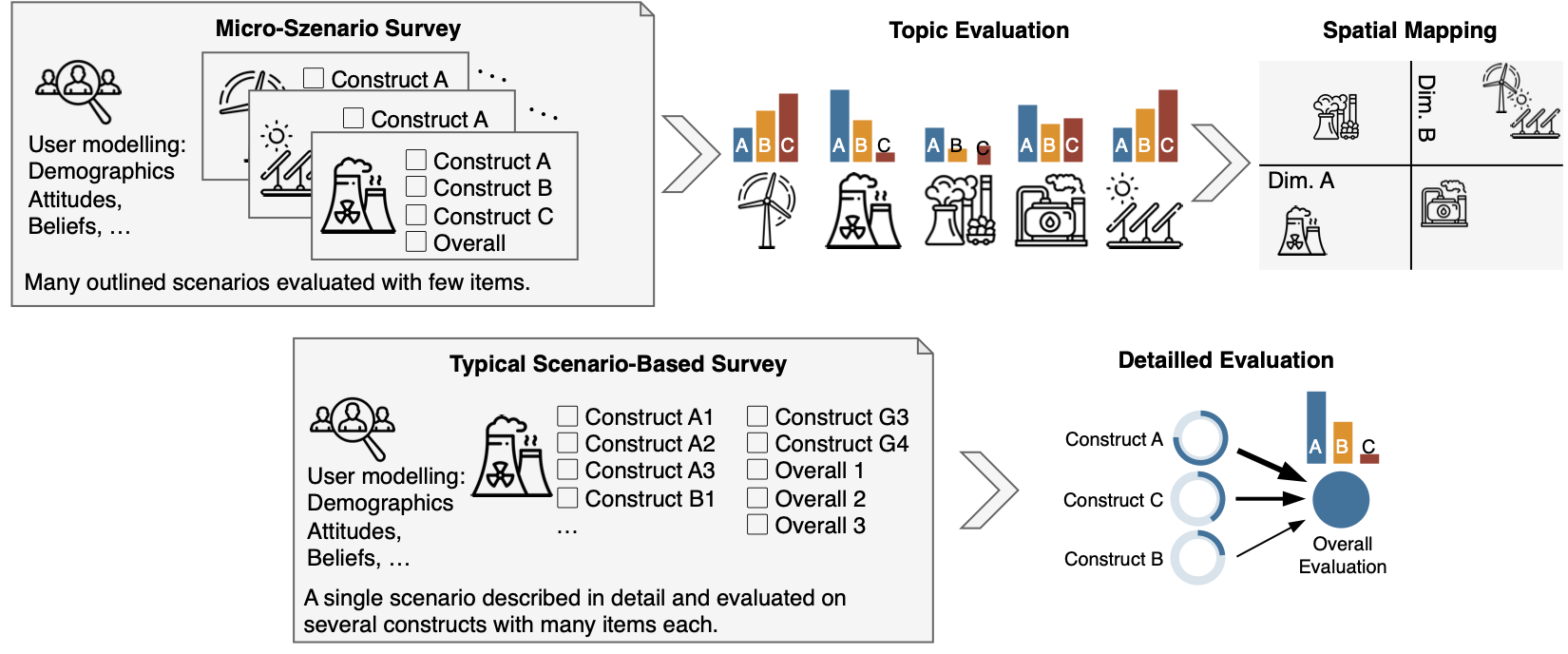
Each of potentially many scenarios is evaluated on the same small set of response items (see Figure 1). Because participants evaluate several scenarios, I recommend using no more than three to five dependent variables. With a suitable set of items as dependent variables, these evaluations provide three complementary research perspectives:
1. Grand mean or overall sentiment: First, the grand mean across topics and participants for each dimension can be understood as an overall evaluation of the topic field—an indicator of general sentiment.
2. Individual differences: The responses can be interpreted as reflexive measurements of latent personality states or traits. In this sense, they represent between-subject variables (or “user variables”). Correlations with other user factors such as age, gender, or background characteristics can then be explored.
3. Topic evaluations: The responses also function as evaluations of the queried topics themselves. This perspective makes it possible to study differences and similarities between topics across the evaluation dimensions.
For example, one might query perceived risk, perceived benefit, and overall value across a range of topics. The first perspective highlights how individuals weigh risks and benefits to form personal value judgments. The second perspective shows how risks and benefits are distributed across the different topics. These assessments can easily be mapped and visualized as accessible scatter plots. The third perspective captures how the entire topic field is perceived in terms of risks, benefits, and value.
Using easy-to-adapt R code, this notebook demonstrates how studies using the micro scenario approach can be prepared, analysed, and visualized. An additional page shows how the synthetic data used to illustrate the analysis was created. Details on this approach, its methodological justifications, and additional practical guidelines can be found in the following research article:
Brauner, Philipp (2024) Mapping acceptance: micro scenarios as a dual-perspective approach for assessing public opinion and individual differences in technology perception. Frontiers in Psychology 15:1419564. doi: 10.3389/fpsyg.2024.1419564 (
.bib)
Real world example of applying Micro Scenarios
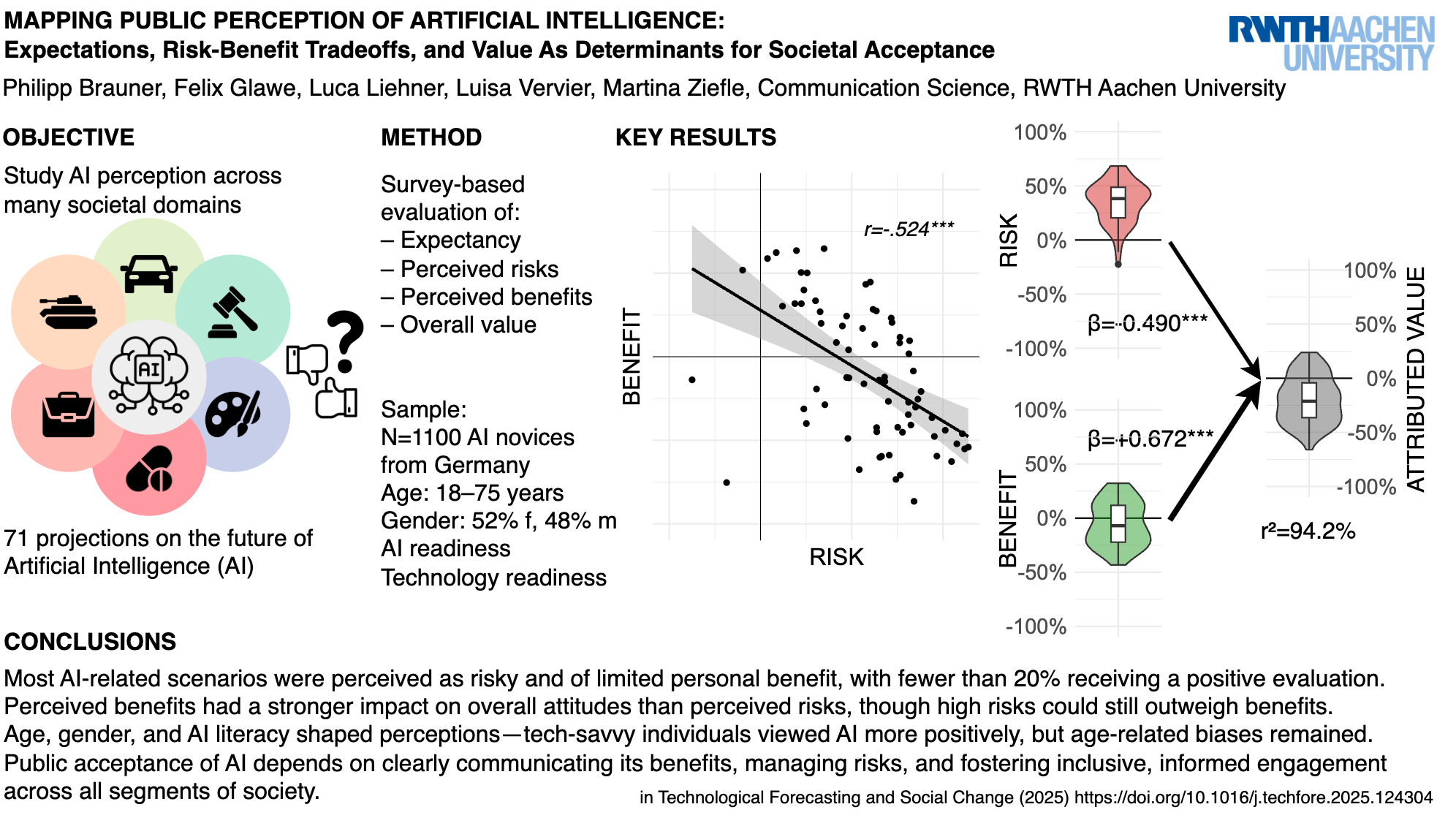
Figure 2 shows a graphical abstract from a refereed article that applied the micro scenario approach in the context of public risk–benefit perception of Artificial Intelligence. On an absolute level, Perceived Risks of AI across many applications are high, while Perceived Benefits and Perceived Value are comparatively low. However, a multiple linear regression suggests that overall Value can be explained (\(r^2 > .9\)) by Perceived Risks (\(\beta = -.490\)) and, to an even larger extent, Perceived Benefits (\(\beta = .672\)). Individual differences further shape these perceptions.
Link to the article:
Brauner P, et al. (2025) Mapping Public Perception of Artificial Intelligence: Expectations, Risk-Benefit Tradeoffs, and Value As Determinants for Societal Acceptance, in Technology Forecasting and Social Change (2025). doi: 10.1016/j.techfore.2025.124304 (
.bib)
Slides
If you prefer slides over websites, you can look at the english slidedeck on the appraoch here:
microscenarios_slides_2025.pdf
List of Studies
Several studies based on this approach have been published or are in the making. I document them in Table 1, including the research context, sample size, number of topics queried, and the dependent variables. If you build on this approach, let me know and I can add your study to the list — just drop me a message!
Reference | Topic | Dependents | Sample |
|---|---|---|---|
Peer-reviewed articles | |||
Artificial Intelligence | Expectancy, Risk, Benefit, Value | 1,219 | |
Health Technologies | Risk, Benefit, Value | 193 | |
Artificial Intelligence | Expectancy, Risk, Benefit, Value | 1,100 | |
Sustainability and restraint | perceived climate effect, cost-benefit,perceived feasability | 108 | |
Various Technologies | Valence,Risk,Familiarity,Desire for Governance | 120 | |
Artificial Intelligence | Expectancy, Risk, Benefit, Value | 110 | |
Artificial Intelligence | Expectancy, Valence | 122 | |
Preprints | |||
This approach evolved over time and through several research projects. I would like to thank all those who have directly or indirectly, consciously or unconsciously, inspired me to take a closer look at this approach and who have given me the opportunity to apply this approach in various contexts. In particular, I would like to thank: Ralf Philipsen, without whom the very first study with that approach would never have happened, as we developed the crazy idea to explore the benefits of barriers of using “side-by-side” questions in Limesurvey. Julia Offermann, for indispensable discussions about this approach and so much encouragement and constructive comments during the last meters of the manuscript. Martina Ziefle for igniting scientific curiosity and motivating me to embark on a journey of boundless creativity and exploration. Felix Glawe, Luca Liehner, and Luisa Vervier for working on a study that took this concept to another level. Julian Hildebrandt for in-depth discussions on the approach and for validating the accompanying code. Tim Schmeckel for feedback on the draft of this article.
Throughout the process I received feedback from editors and reviewers that helped to question this approach and improve the foundation of this approach. No scientific method of the social sciences alone will fully answer all of our questions. I hope that this method provides a fresh perspective on exciting and relevant questions.
Funded by the Deutsche Forschungsgemeinschaft (DFG, German Research Foundation) under Germany’s Excellence Strategy – EXC- 2023 Internet of Production – 390621612.